Does Homeowners Insurance Cover a Burst Pipe?
Usually yes — if the burst was sudden and accidental. Here's the distinction insurers draw, the exclusions that catch homeowners off guard, and how to document a claim.
Insurance basics
The Short Answer, Then the Details
Important up front: this is general information about how homeowners insurance typically treats burst pipes. It is not insurance or legal advice, and every policy is different — check your own policy or talk to your agent for specifics.
The rule insurers use: sudden vs. gradual
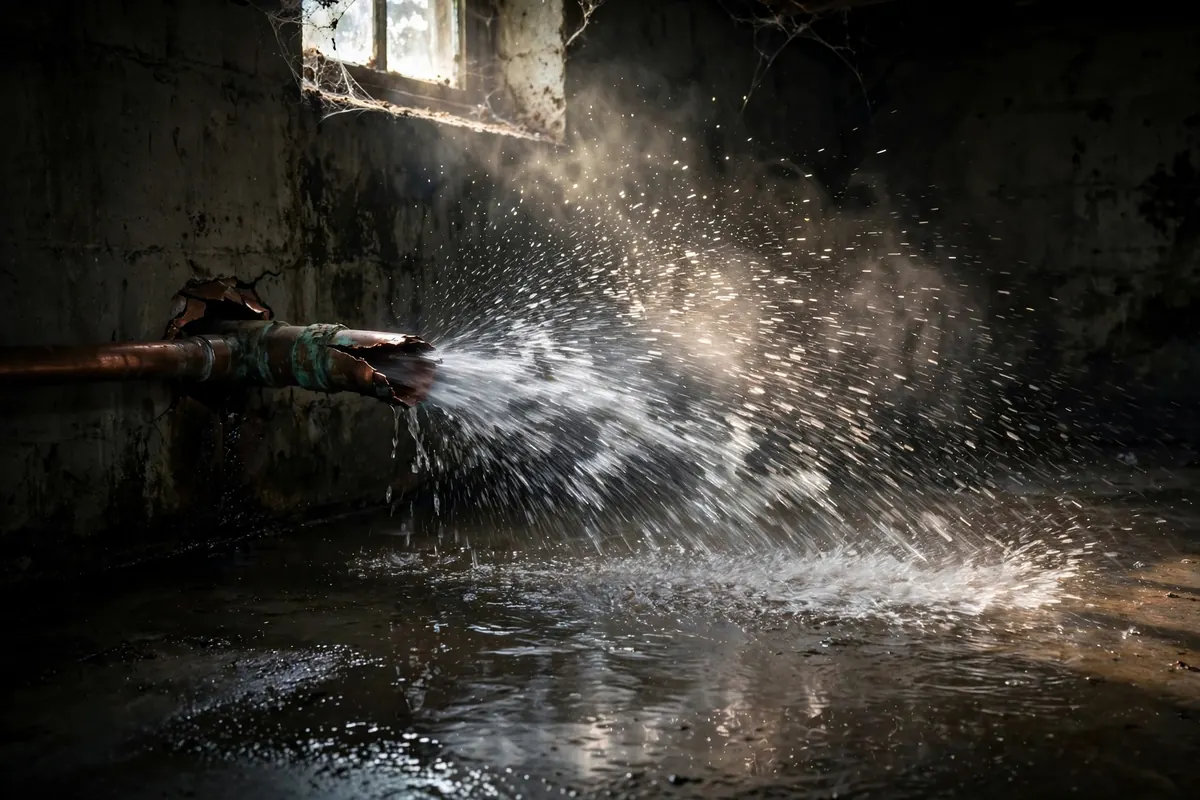
Homeowners insurance generally covers sudden and accidental water damage. A pipe that freezes and splits during a January cold snap is the textbook example: one moment the pipe is fine, the next it has failed, and water is damaging walls, floors, and belongings. That resulting water damage — drywall, flooring, furniture, personal property — is typically what the policy pays for.
What the policy usually does not cover is the pipe itself, or damage from anything slow. A joint that's been weeping for two years, a corroded galvanized line that's been rusting since the house was built, a shower valve that dripped into the wall cavity for months — those are gradual problems, and insurers treat them as maintenance the homeowner should have handled. The dividing line is accident vs. neglect: sudden failure is covered, slow failure usually isn't. This is also why the cause of the burst matters as much as the damage it did — an adjuster will ask both questions.
What's typically covered
In a standard burst-pipe scenario, coverage usually extends to the damage the escaping water caused: soaked drywall, warped flooring, damaged ceilings below the break, and belongings that got wet. If the burst forces you out of the house during repairs, many policies also include loss-of-use coverage for temporary living costs — again, check your own policy for limits.
The exclusions that catch people off guard
Three exclusions matter most for Naugatuck winters:
- The unheated-home exclusion. If a pipe freezes because the house was left unheated — heat turned off entirely, or set below what the policy requires — the resulting damage is often excluded. Many policies require you to maintain heat (commonly around 55°F) or to shut off and drain the water system if you'll be away in winter. A January freeze in an empty, unheated house is the classic denied claim.
- Long-term leaks and neglect. If the insurer's adjuster finds evidence the leak predated the "burst" — water stains layered over months, mold growth, rot — the claim can be denied as gradual damage even if the pipe technically failed suddenly.
- Wear and tear. Corrosion-related failure in a 60-year-old galvanized line may be treated as a system at end of life rather than an accident. The water damage may still be covered even when the pipe replacement itself isn't.
Documentation that makes or breaks a claim
Claims are won and lost on evidence, and the evidence is perishable — it gets cleaned up. Before anything is moved or dried:
- Photograph and video everything — the burst pipe, the water path, every damaged surface, every damaged belonging. Wide shots for context, close-ups for detail.
- Keep the damaged pipe section if it was removed during repair. Don't let it go in the trash.
- Make a written inventory of damaged belongings with approximate values.
- Save every receipt — emergency plumbing work, water extraction, temporary repairs, hotel stays.
- Note the timeline — when you discovered the water, what the weather was doing, what steps you took. Freeze-related claims are stronger with a clear weather record.
Filing: the practical sequence
Call your insurer early — most policies require prompt notice. Mitigate further damage (that's your duty under the policy: shut off water, contain, start drying), but don't start permanent repairs or throw away damaged materials until the adjuster has seen them. Keep copies of everything you submit. And get the repair done properly: a professional cut-and-replace with proper couplings, permitted where the job requires it, leaves a clean paper trail — a botched DIY repair can complicate a claim, especially if it fails again or violates local code.
Where we fit in
We're plumbers, not adjusters — we can't tell you what your policy covers. But on every burst pipe repair in Naugatuck we do, we can tell you what caused the failure, whether it looks sudden or long-developing, and what the repair involved. That factual record — what broke, why, and how it was fixed — is exactly what an adjuster asks for. Take the photos, keep the receipts, call your agent, and let us handle the pipe.
Pipe Burst? Fix the Leak First, Sort the Paperwork After.
Call FlowFix — we'll stop the water, repair the pipe properly, and give you a clear record of what failed and why, ready for your adjuster.