PEX vs. Copper: Which Handles Freezing Better?
One flexes, one doesn't — and that difference decides which pipe survives a Naugatuck January. The full comparison, including the weak point nobody mentions.
Materials guide
Why Freezing Is a Materials Question
When water freezes, it expands about nine percent. What happens next depends entirely on what the pipe is made of.
Copper under freeze: strong, but rigid
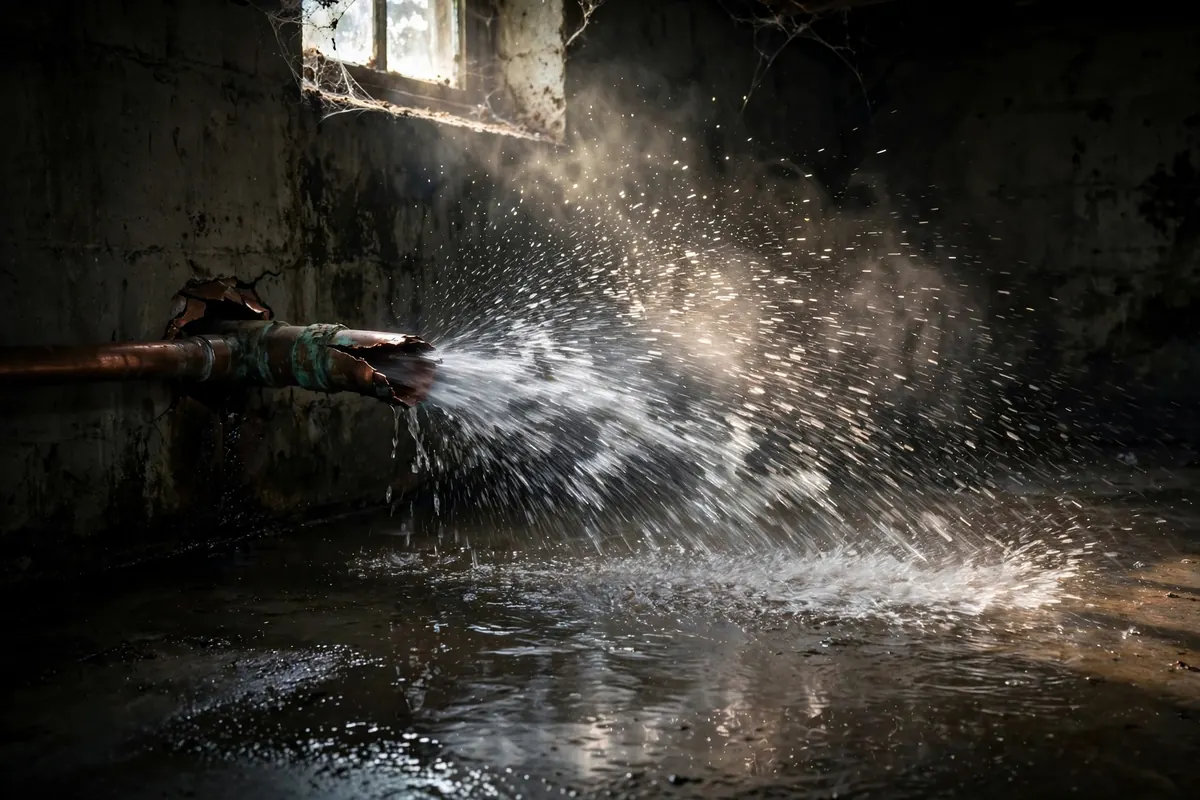
Copper is an excellent pipe in every season except the one that matters most in Connecticut. It's durable, corrosion-resistant, and can last decades — the mid-century copper runs in Naugatuck's 1950s–1970s homes are often still structurally sound. But copper is rigid. When ice expands inside it, the pipe can't flex to absorb the pressure, so the pressure spikes until the wall gives way at its weakest point — usually a one-to-six-inch lengthwise split. Copper doesn't forgive a freeze; it holds and holds, and then it splits.
That said, healthy copper is not fragile. A well-installed copper line in a heated wall handles normal winters fine. The failures we see are copper in unheated spaces, on exterior walls, or in homes where the heat was set too low — situations where any rigid pipe would be in trouble.
PEX under freeze: flexible, not invincible
PEX (cross-linked polyethylene) is the material used in most new and repiped plumbing, and its freeze advantage is simple physics: it's flexible. When water freezes inside PEX, the tubing can expand — up to roughly three times its diameter in extreme cases — and then contract back as the ice melts. The pressure that splits copper gets absorbed by the tubing wall instead. That's why PEX is described as freeze-resistant.
The key word is resistant, not proof. PEX can still burst in a freeze — it just takes more. A hard, prolonged freeze with nowhere for pressure to go will eventually exceed even PEX's flexibility. And that brings us to the part people skip.
The weak point: fittings
Here's what nobody mentions in the PEX-vs-copper debate: the tubing isn't the whole system. PEX joints use brass or plastic fittings — elbows, tees, couplings — and those fittings are rigid. They don't flex with the tubing. In a freeze event, the expanding ice pressurizes the whole line, and the rigid fittings become the failure points: cracked fitting bodies, blown-out connections, split crimp rings. A PEX system with its runs surviving and its fittings failing is still a burst-pipe emergency. The material advantage is real, but it's the tubing's advantage — the joints still need protection from freezing like everything else.
The rest of the comparison
Freeze performance isn't the only factor, and for a fair picture, the other differences matter:
- Durability. Copper resists UV, rodents, and high temperatures better than PEX. PEX can't go where sunlight hits it and is vulnerable to rodent chewing in some installations.
- Installation. PEX is faster and cheaper to install — it snakes through walls in long runs with fewer joints, and fewer joints means fewer potential failure points. Copper requires soldering at every joint.
- Water quality. Both are safe for drinking water. Copper has natural antimicrobial properties; PEX is inert and doesn't corrode.
- Lifespan. Both are rated for decades. Copper's track record is longer simply because it's been in use longer.
What this means for Naugatuck homes
Most burst pipes we repair in Naugatuck aren't in PEX or copper at all — they're in the galvanized steel still sitting in the borough's pre-1950 homes, corroded from the inside until a freeze finishes the job. For those homes, the real question isn't PEX vs. copper in the abstract; it's what replaces a failing galvanized system. And there, PEX is the common answer for good reasons: it threads through old walls with minimal opening, it needs fewer joints, and its freeze flexibility is genuine insurance against the next cold snap.
For a homeowner choosing between the two in a repipe: PEX handles freezing better, full stop — with the honest caveat that fittings remain the weak point and no pipe should be left to freeze unprotected. Copper remains a fine, durable choice in heated spaces. The decision usually comes down to budget, the home's layout, and the condition of what's already in the walls — which is exactly the kind of call a plumber makes on site, not on the internet. If your Naugatuck home is still running on galvanized lines and you're weighing a repipe, call (475) 323-1857 — from burst pipe repair in Naugatuck to full repipes, we'll look at what's actually in your walls and give you a straight recommendation.
Old Galvanized Lines? Let's Talk Repipe.
If your home still runs on corroded galvanized pipe, every freeze is a gamble. Call FlowFix — we'll assess the system and lay out your replacement options honestly.