How to Thaw a Frozen Pipe Safely
A frozen pipe that hasn't burst yet can usually be saved. Here's how to thaw it without turning a close call into a flood.
Emergency guide
Confirm It's Frozen, Then Work Carefully
Thawing is safe when it's done with controlled heat and patience. It's dangerous when it's rushed — with the wrong tool or the wrong direction.
Signs the pipe is frozen, not broken
The classic sign: a faucet that produces nothing — or a thin trickle — during freezing weather, while other faucets in the house work fine. That tells you the blockage is in the line feeding that one fixture. Supporting clues: visible frost on an exposed section of pipe, a pipe that feels ice-cold and rigid to the touch, or odd smells from a drain (frozen drain lines trap sewer gases). If water is actively leaking anywhere, it's not just frozen — shut off the main and call a plumber.
Before you start: open the faucet
Open the faucet that the frozen pipe feeds, and leave it open. This does two critical things. First, it gives the melting water somewhere to go, so pressure doesn't build up behind the thaw. Second, it relieves the pressure spike that actually splits pipes — the same reason dripping faucets during a freeze helps. You'll know the thaw is working when water starts flowing again. Keep the faucet open until full flow returns.
Safe thawing methods
Use controlled, moderate heat — never concentrated or uncontrolled:
- Hair dryer or heat gun on a low setting. The standard tool. Keep it moving along the pipe, don't hold it in one spot, and keep a safe distance so you warm the pipe rather than scorch it.
- Hot towels. Soak towels in hot water, wring them out, and wrap the frozen section. Replace them as they cool. Slower than a heat gun, but very safe and good for pipes you can't easily reach with a dryer.
- Space heater in the area. For a frozen run in a crawlspace or basement, a space heater warming the general area works — placed near the pipe but not touching it, and never left unattended.
- Warm the room. If the frozen pipe is behind a cabinet or in a wall cavity, opening cabinet doors and turning up the heat in the room lets warm air do the work.
Work from the faucet back toward the frozen section
Direction matters. Start applying heat at the faucet end and work backward toward the frozen blockage. This lets melt water and steam escape through the open faucet instead of getting trapped between the ice and a closed tap — trapped pressure is exactly what splits pipes. Work slowly along the run in sections. Thawing a pipe is measured in tens of minutes, not seconds; rushing it with excessive heat is how pipes get damaged.
Never use an open flame
This needs to be said plainly: never use a blowtorch, propane torch, or any open flame to thaw a pipe. Flame is the wrong tool for three reasons. It can ignite wood framing, insulation, or dust inside walls and start a house fire. It superheats a small section of pipe while the ice blockage remains, creating a steam-pressure spike that can burst the very pipe you're trying to save. And on PEX or CPVC, direct flame melts or weakens the tubing itself. Every safe method above works without flame — there is no situation where flame is the right answer.
Watch for leaks as the ice melts
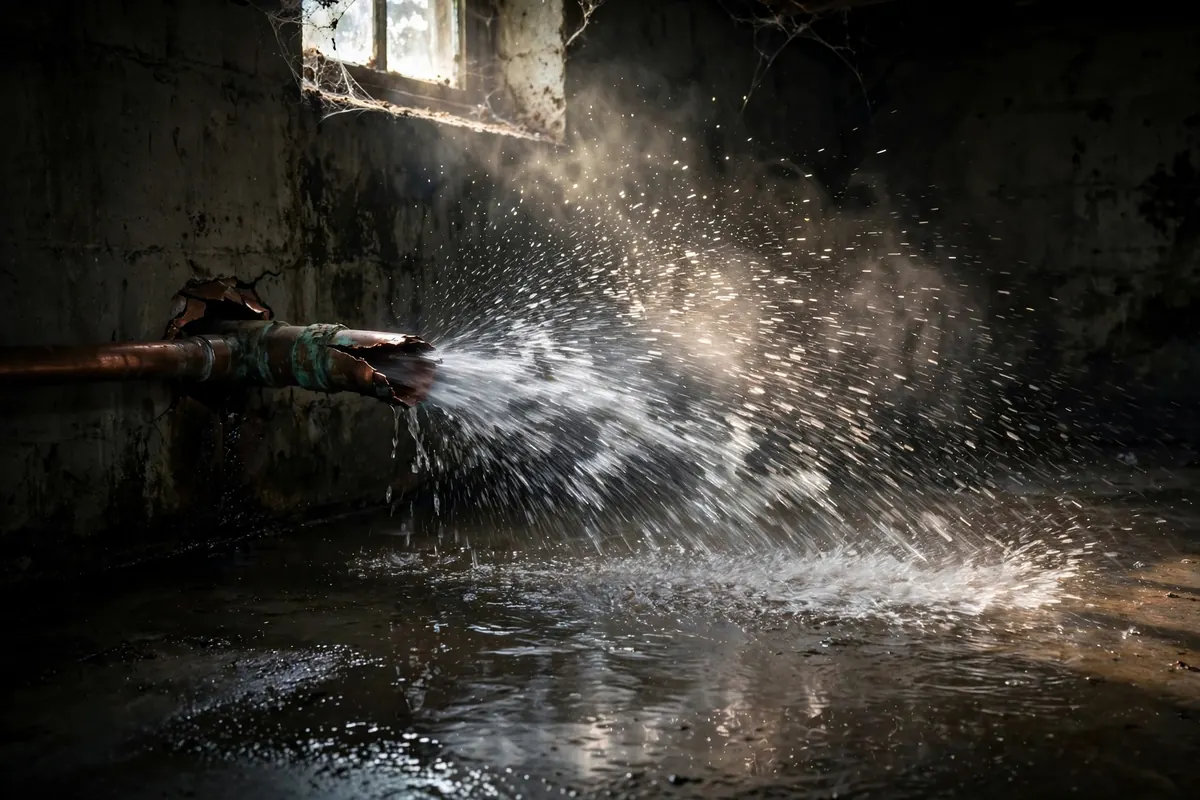
Here's the part people miss: the ice may be the only thing plugging a split. As the pipe thaws, a freeze crack can start leaking — water appearing where the pipe was "fine" a minute ago. Stay with the pipe while it thaws, and know where your main shutoff is before you start. If water appears at the thaw site, shut off the main immediately: the pipe has split and needs a repair, not more thawing. A split of one to six inches is typical for a freeze burst — the damaged section gets cut out and replaced with proper couplings.
If the frozen pipe is inside a wall
Frozen pipes in exterior walls are harder: you can't reach the pipe directly. Open the faucet, turn up the room heat, and consider cutting a small access opening in the interior drywall to get warm air (or a hair dryer) to the pipe — interior drywall is far easier to patch than the alternative. If you're not comfortable opening the wall, or if the freeze is in a spot you can't identify, call a plumber: we thaw frozen lines with controlled heat, check the full run for weak spots, and repair any splits the thaw reveals. That's the frozen pipe thawing work we do across Naugatuck every winter — call (475) 323-1857 before a frozen line becomes a burst one.
Frozen Pipe You Can't Reach? Don't Risk It.
Call FlowFix — we'll thaw the line safely with controlled heat, check the full run for damage, and fix any splits the thaw reveals.